4
0
Support the library.
Your support helps keep books free for everyone ❤️
📍 Noticed
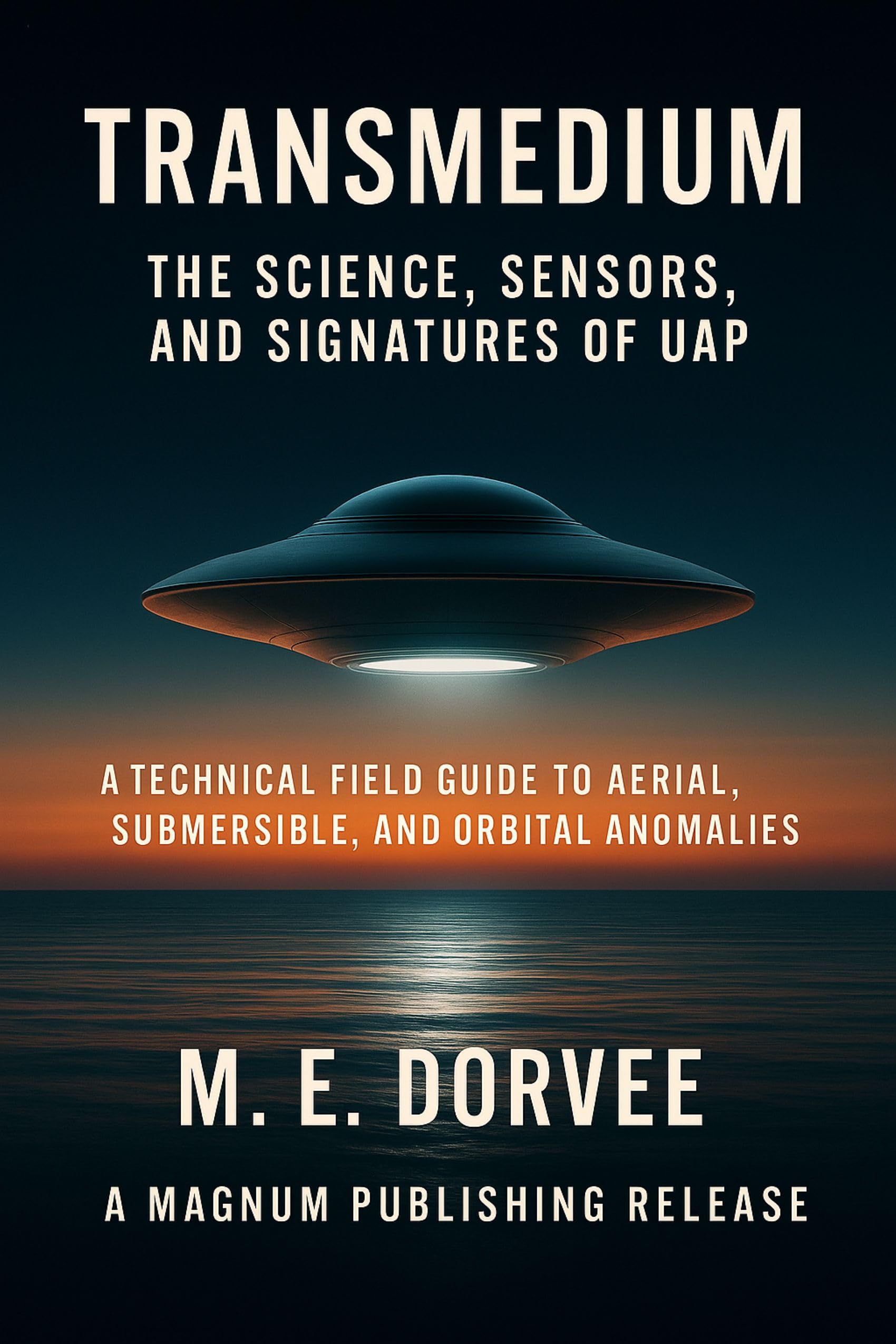
Transmedium - The Science, Sensors, and Signatures of UAP: A Technical Field Guide to Aerial, Submersible, and Orbital Anomalies (The UAP Disclosure Collection Book 5)
by M.E. Dorvee
Sponsored
Synopsis
Unidentified Aerial Phenomena (UAP)—once relegated to the fringes of fringe science—have surged into the forefront of national security, aerospace engineering, and scientific inquiry. From the declassified U.S. Navy "Tic Tac" encounter off the USS Nimitz in 2004 to the 2021 Office of the ...
Unidentified Aerial Phenomena (UAP)—once relegated to the fringes of fringe science—have surged into the forefront of national security, aerospace engineering, and scientific inquiry. From the declassified U.S. Navy "Tic Tac" encounter off the USS Nimitz in 2004 to the 2021 Office of the Director of National Intelligence (ODNI) preliminary assessment acknowledging 144 unexplained cases, UAP represent a multifaceted detection challenge that spans atmospheric, oceanic, and orbital domains. Transmedium: The Science, Sensors, and Signatures of UAP—the fifth volume in this investigative series—delivers a rigorously technical field guide engineered for precision rather than speculation. This is not a compendium of eyewitness anecdotes or conspiracy-laden narratives; it is a sensor-centric blueprint for decoding how anomalous objects are observed, tracked, validated, and distinguished from prosaic phenomena across the electromagnetic spectrum, acoustic regimes, and multi-density interfaces.
At its core, UAP investigation is a sensor fusion problem: raw data streams from disparate platforms—radar, infrared (IR), electro-optical (EO), sonar, satellite reconnaissance, and passive RF monitoring—must be correlated in time, space, and phenomenology to separate signal from noise. The book's three foundational pillars—phenomenology (the physical behaviors exhibited), instrumentation (the hardware and software that capture them), and uncertainty (quantifying false positives, artifacts, and methodological gaps)—underpin every chapter. Drawing exclusively from authoritative, declassified, and peer-reviewed sources—including All-Domain Anomaly Resolution Office (AARO) public releases, NASA Independent UAP Study Team findings, France's GEIPAN archival case files, the UK's Project Condign plasma studies, FAA/ICAO reporting protocols, and DoD/NORTHCOM telemetry memos—this volume equips readers with reproducible methodologies to transform ambiguous sightings into evidentiary datasets.
Structured across 18 tightly focused chapters (each 20–28 pages with embedded figures, tables, and diagnostic sidebars), the text progresses from foundational physics to advanced multi-sensor architectures. Early chapters demystify electromagnetic and radar fundamentals, dissecting historical benchmarks like the 1952 Washington, D.C. radar-visual swarm and modern SPY-6 phased-array tracks. Mid-volume sections tackle transmedium kinematics—analyzing cavitation thresholds, supercavitation envelopes, and the hydrodynamic impossibilities claimed in "Tic Tac"-style USO correlates—while rigorously debunking optical illusions (mirages, bokeh saturation, parallax-induced motion) and electronic warfare spoofing (DRFM jamming, decoy kinematics). Later chapters pivot to operational realities: space-based surveillance constraints, civilian ADS-B/MLAT fusion, machine learning anomaly triage, and international data-sharing barriers under NATO protocols.
The culmination is a prescriptive roadmap for "gold-standard" UAP incidents: minimum evidentiary thresholds, time-synced multisensor provenance, and a quantifiable scoring rubric. Appendices provide field-ready tools—sensor glossaries, misidentification quick-guides, FOIA navigation templates, and an annotated bibliography of 150+ peer-reviewed atmospheric, sensor, and aerospace papers. Enhanced with 12–16 pages of original diagrams (radar beam geometry, IR glare propagation, Kalman-filter track correlation flows), this book is optimized for defense analysts, aviation engineers, policy staffers, and citizen investigators alike. By prioritizing instrumentation over ideology, Transmedium charts a falsifiable path from anecdote to repeatable science—ensuring that the next transmedium anomaly is met not with wonder, but with calibrated sensors and unimpeachable data.