1
0
Support the library.
Your support helps keep books free for everyone ❤️
📍 Noticed
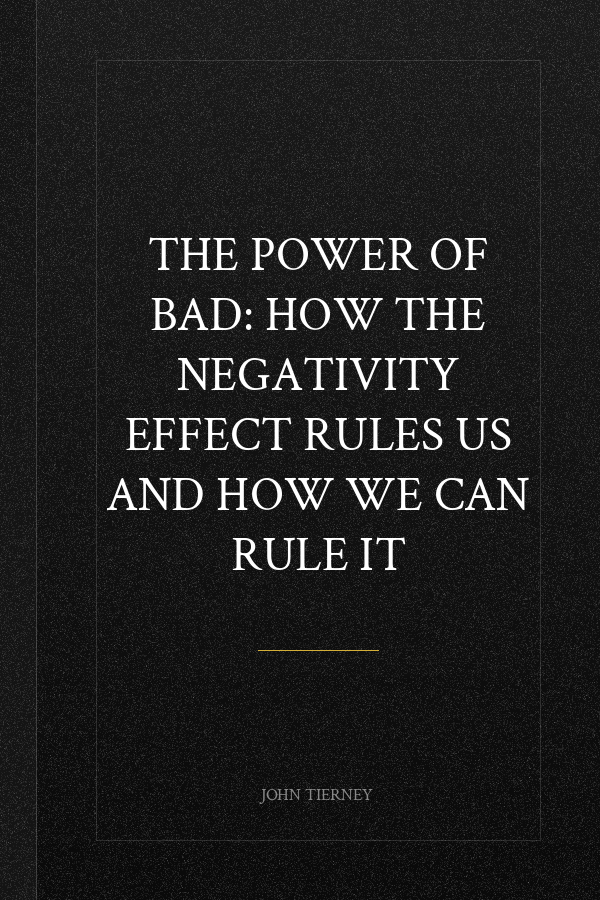
The Power of Bad: How the Negativity Effect Rules Us and How We Can Rule It
by John Tierney
Sponsored
Synopsis
The most important book at the borderland of psychology and politics that I have ever read.--Martin E. P. Seligman, Zellerbach Family Professor of Psychology at that University of Pennsylvania and author of Learned Optimism Why are we devastated by a word of criticism even ...
The most important book at the borderland of psychology and politics that I have ever read.--Martin E. P. Seligman, Zellerbach Family Professor of Psychology at that University of Pennsylvania and author of Learned Optimism
Why are we devastated by a word of criticism even when it's mixed with lavish praise? Because our brains are wired to focus on the bad. This negativity effect explains things great and small: why countries blunder into disastrous wars, why couples divorce, why people flub job interviews, how schools fail students, why football coaches stupidly punt on fourth down. All day long, the power of bad governs people's moods, drives marketing campaigns, and dominates news and politics.
Eminent social scientist Roy F. Baumeister stumbled unexpectedly upon this fundamental aspect of human nature. To find out why financial losses mattered more to people than financial gains, Baumeister looked for situations in which good events made a bigger impact than bad ones. But his team couldn't find any. Their research showed that bad is relentlessly stronger than good, and their paper has become one of the most-cited in the scientific literature.
Our brain's negativity bias makes evolutionary sense because it kept our ancestors alert to fatal dangers, but it distorts our perspective in today's media environment. The steady barrage of bad news and crisismongering makes us feel helpless and leaves us needlessly fearful and angry. We ignore our many blessings, preferring to heed--and vote for--the voices telling us the world is going to hell.
But once we recognize our negativity bias, the rational brain can overcome the power of bad when it's harmful and employ that power when it's beneficial. In fact, bad breaks and bad feelings create the most powerful incentives to become smarter and stronger. Properly understood, bad can be put to perfectly good use.
As noted science journalist John Tierney and Baumeister show in this wide-ranging book, we can adopt proven strategies to avoid the pitfalls that doom relationships, careers, businesses, and nations. Instead of despairing at what's wrong in your life and in the world, you can see how much is going right--and how to make it still better.
Why are we devastated by a word of criticism even when it's mixed with lavish praise? Because our brains are wired to focus on the bad. This negativity effect explains things great and small: why countries blunder into disastrous wars, why couples divorce, why people flub job interviews, how schools fail students, why football coaches stupidly punt on fourth down. All day long, the power of bad governs people's moods, drives marketing campaigns, and dominates news and politics.
Eminent social scientist Roy F. Baumeister stumbled unexpectedly upon this fundamental aspect of human nature. To find out why financial losses mattered more to people than financial gains, Baumeister looked for situations in which good events made a bigger impact than bad ones. But his team couldn't find any. Their research showed that bad is relentlessly stronger than good, and their paper has become one of the most-cited in the scientific literature.
Our brain's negativity bias makes evolutionary sense because it kept our ancestors alert to fatal dangers, but it distorts our perspective in today's media environment. The steady barrage of bad news and crisismongering makes us feel helpless and leaves us needlessly fearful and angry. We ignore our many blessings, preferring to heed--and vote for--the voices telling us the world is going to hell.
But once we recognize our negativity bias, the rational brain can overcome the power of bad when it's harmful and employ that power when it's beneficial. In fact, bad breaks and bad feelings create the most powerful incentives to become smarter and stronger. Properly understood, bad can be put to perfectly good use.
As noted science journalist John Tierney and Baumeister show in this wide-ranging book, we can adopt proven strategies to avoid the pitfalls that doom relationships, careers, businesses, and nations. Instead of despairing at what's wrong in your life and in the world, you can see how much is going right--and how to make it still better.
You May Also Like

You Are the Map
Michelle Tudor

Hitler: A Study in Tyranny – A Classic Biography: Authoritative and Readable, Abridged
Alan Bullock
Say It Skillfully: Speak Up. Make Your Words Matter. Win Together.
Molly Tschang

The May House: A Novel
Jillian Cantor

Sniff Squad: Dog Training for Kids Who Love Mysteries : Family Fun Activities, Detective Games, and Adventures for Kids Teaching Dogs Scent Skills
Agent Max

Sudoku Puzzles for Adults (Kindle Scribe Only) : Easy Level , Includes Full Solutions
Mima Paper
Cookbooks Picks
View All
Half Baked Harvest Every Day: Recipes for Balanced, Flexible, Feel-Good Meals
Tieghan Gerard

The In Death Cookbook: To-Die-For Recipes from the World of J. D. Robb
Theresa Carle-Sanders

Cravings: All Together: Recipes to Love
Chrissy Teigen

Smitten Kitchen Keepers: New Classics for Your Forever Files
Deb Perelman

The Pioneer Woman Cooks―Dinner's Ready!: Fast Family Dinner Recipes from Ree Drummond for Easy Weeknight Meals, Comfort Food, and Sides
Ree Drummond

Baking Across America: A Vintage Recipe Road Trip
B. Dylan Hollis
