2
0
Support the library.
Your support helps keep books free for everyone ❤️
📍 Noticed
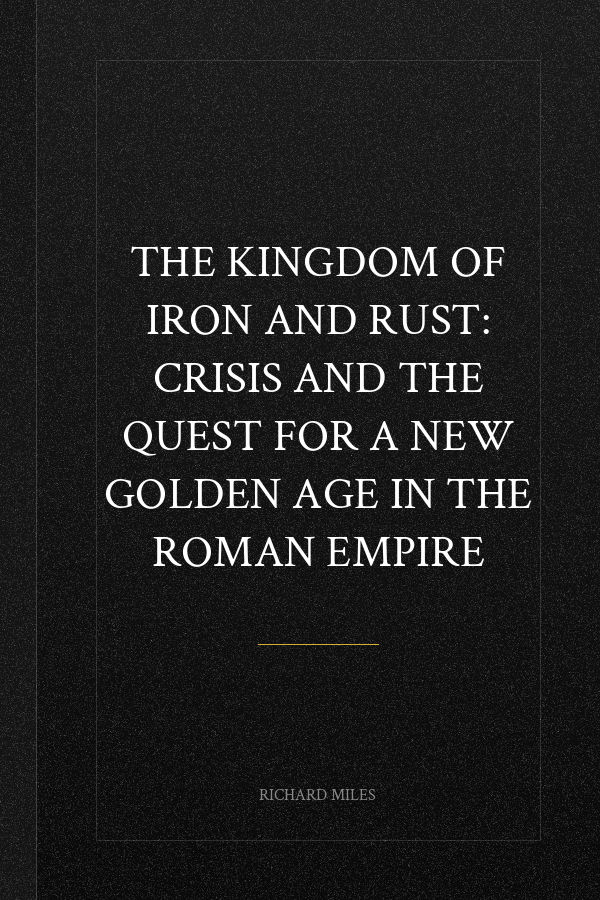
The Kingdom of Iron and Rust: Crisis and the Quest for a New Golden Age in the Roman Empire
by Richard Miles
Sponsored
Synopsis
An exciting new history of the Roman Empire's struggle for survival in a turbulent era rocked by crises, when the specter of its decline and fall loomed over it as never before.Rome's decline, as historian Cassius Dio famously put it, "from a kingdom of gold to one of iron and rust," ...
An exciting new history of the Roman Empire's struggle for survival in a turbulent era rocked by crises, when the specter of its decline and fall loomed over it as never before.
Rome's decline, as historian Cassius Dio famously put it, "from a kingdom of gold to one of iron and rust," seemed inevitable. After a brilliant Golden Age, the ominous specter of crisis, chaos, and collapse loomed over the Roman Empire. The first cracks began to appear during the celebrated rule of Marcus Aurelius with a series of bloody wars against marauding barbarians who smashed through the Empire's northern frontiers. In the succeeding decades the Empire was rocked by a series of bloody usurpations, civil wars, barbarian attacks, epidemics and economic woes.
In The Kingdom of Iron and Rust, Richard Miles examines the impact of these military, political, social, and economic setbacks on the Roman Empire during the third and fourth centuries AD. These crises were often conflated and exaggerated by emperors and religious and intellectual elites to promote their own aims and agendas. By endlessly prophesising the decline and fall of the Empire, these leaders manipulated public opinion by promoting themselves as saviours who would lead Rome into a new golden age. Miles argues that this catastrophising, although often a cynical political ploy, created the conditions for a series of visionary emperors to implement the radical reforms required to revitalise the Roman Empire at a time when its dominance was under threat as never before from internal fragmentation and external foes.
In this sweeping history that takes readers from sprawling army bases in the Sahara to the blood-drenched halls of the imperial court, from the high-brow philosophical schools to the apocalypse-obsessed religious cults, Miles demonstrates how the Roman obsession with their empire's inevitable demise acted as a self-fulfilling prophecy. Miles asks the question of whether it was only through crisis, both real and imagined, that the imperial behemoth that was the Roman Empire managed to sustain its greatness.
Rome's decline, as historian Cassius Dio famously put it, "from a kingdom of gold to one of iron and rust," seemed inevitable. After a brilliant Golden Age, the ominous specter of crisis, chaos, and collapse loomed over the Roman Empire. The first cracks began to appear during the celebrated rule of Marcus Aurelius with a series of bloody wars against marauding barbarians who smashed through the Empire's northern frontiers. In the succeeding decades the Empire was rocked by a series of bloody usurpations, civil wars, barbarian attacks, epidemics and economic woes.
In The Kingdom of Iron and Rust, Richard Miles examines the impact of these military, political, social, and economic setbacks on the Roman Empire during the third and fourth centuries AD. These crises were often conflated and exaggerated by emperors and religious and intellectual elites to promote their own aims and agendas. By endlessly prophesising the decline and fall of the Empire, these leaders manipulated public opinion by promoting themselves as saviours who would lead Rome into a new golden age. Miles argues that this catastrophising, although often a cynical political ploy, created the conditions for a series of visionary emperors to implement the radical reforms required to revitalise the Roman Empire at a time when its dominance was under threat as never before from internal fragmentation and external foes.
In this sweeping history that takes readers from sprawling army bases in the Sahara to the blood-drenched halls of the imperial court, from the high-brow philosophical schools to the apocalypse-obsessed religious cults, Miles demonstrates how the Roman obsession with their empire's inevitable demise acted as a self-fulfilling prophecy. Miles asks the question of whether it was only through crisis, both real and imagined, that the imperial behemoth that was the Roman Empire managed to sustain its greatness.
You May Also Like

How We Show Up: Reclaiming Family, Friendship, and Community
Mia Birdsong

The Book of Forbidden Feelings
Lala Bohang

The First Tycoon: The Epic Life of Cornelius Vanderbilt (Pulitzer Prize Winner)
T.J. Stiles
Mapplethorpe Flora: The Complete Flowers
Robert Mapplethorpe
Stealing Propeller Hats from the Dead
David James Keaton
Think Again
Michael Maltasanti
Cookbooks Picks
View All
What's for Dessert: Simple Recipes for Dessert People
Claire Saffitz

Half Baked Harvest Every Day: Recipes for Balanced, Flexible, Feel-Good Meals
Tieghan Gerard

All Consuming: Why We Eat the Way We Eat Now
Ruby Tandoh

Food Person
Adam D. Roberts

Baking Yesteryear: The Best Recipes from the 1900s to the 1980s
B. Dylan Hollis

We Are What We Eat: A Slow Food Manifesto
Alice Waters
