1
0
Support the library.
Your support helps keep books free for everyone ❤️
📍 Noticed
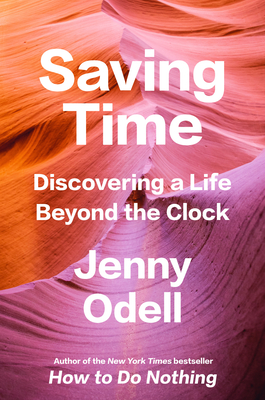
Saving Time: Discovering a Life Beyond the Clock
by Jenny Odell
Sponsored
Synopsis
In her first book, How to Do Nothing, Jenny Odell wrote about the importance of disconnecting from the “attention economy” to spend time in quiet contemplation. But what if you don’t have time to spend?
In order to answer this seemingly simple question, Odell took a deep dive ...
In order to answer this seemingly simple question, Odell took a deep dive ...
In her first book, How to Do Nothing, Jenny Odell wrote about the importance of disconnecting from the “attention economy” to spend time in quiet contemplation. But what if you don’t have time to spend?
In order to answer this seemingly simple question, Odell took a deep dive into the fundamental structure of our society and found that the clock we live by was built for profit, not people. This is why our lives, even in leisure, have come to seem like a series of moments to be bought, sold, and processed ever more efficiently. Odell shows us how our painful relationship to time is inextricably connected not only to persisting social inequities but to the climate crisis, existential dread, and a lethal fatalism.
This dazzling, subversive, and deeply hopeful book offers us different ways to experience time—inspired by pre-industrial cultures, ecological cues, and geological timescales—that can bring within reach a more humane, responsive way of living. As planet-bound animals, we live inside shortening and lengthening days alongside gardens growing, birds migrating, and cliffs eroding; the stretchy quality of waiting and desire; the way the present may suddenly feel marbled with childhood memory; the slow but sure procession of a pregnancy; the time it takes to heal from injuries. Odell urges us to become stewards of these different rhythms of life in which time is not reducible to standardized units and instead forms the very medium of possibility.
Saving Time tugs at the seams of reality as we know it—the way we experience time itself—and rearranges it, imagining a world not centered on work, the office clock, or the profit motive. If we can “save” time by imagining a life, identity, and source of meaning outside these things, time might also save us.
In order to answer this seemingly simple question, Odell took a deep dive into the fundamental structure of our society and found that the clock we live by was built for profit, not people. This is why our lives, even in leisure, have come to seem like a series of moments to be bought, sold, and processed ever more efficiently. Odell shows us how our painful relationship to time is inextricably connected not only to persisting social inequities but to the climate crisis, existential dread, and a lethal fatalism.
This dazzling, subversive, and deeply hopeful book offers us different ways to experience time—inspired by pre-industrial cultures, ecological cues, and geological timescales—that can bring within reach a more humane, responsive way of living. As planet-bound animals, we live inside shortening and lengthening days alongside gardens growing, birds migrating, and cliffs eroding; the stretchy quality of waiting and desire; the way the present may suddenly feel marbled with childhood memory; the slow but sure procession of a pregnancy; the time it takes to heal from injuries. Odell urges us to become stewards of these different rhythms of life in which time is not reducible to standardized units and instead forms the very medium of possibility.
Saving Time tugs at the seams of reality as we know it—the way we experience time itself—and rearranges it, imagining a world not centered on work, the office clock, or the profit motive. If we can “save” time by imagining a life, identity, and source of meaning outside these things, time might also save us.
You May Also Like

Sisters of the Vast Black
Lina Rather

The Complete ACCUPLACER Study Guide : 1000+ Practice Questions & 6 Full-Length Simulations to Skip Remedial Classes, Save Time, and Start College Strong—Even If Math Makes You Panic
Avery Matheson

Fremtidsdrømmer
Inger Harriet Hegstad

Ghosted
Talia Tucker

The Lost House
Melissa Larsen
The Way I Used to Be Collection (Boxed Set): The Way I Used to Be; The Way I Am Now (The Way I Used to Be, #1-2)
Amber Smith
Classics Picks
View All
Being Thomas Jefferson: An Intimate History
Andrew Burstein

A Fever in the Heartland: The Ku Klux Klan's Plot to Take Over America, and the Woman Who Stopped Them
Timothy Egan

Frankenstein: The 1818 Text
Mary Wollstonecraft Shelley

Enola Holmes and the Clanging Coffin
Nancy Springer

The Black Cross: A History of the Baltic Crusades
Aleksander Pluskowski

We Do Not Part
Han Kang
