13
0
Support the library.
Your support helps keep books free for everyone ❤️
📍 Noticed
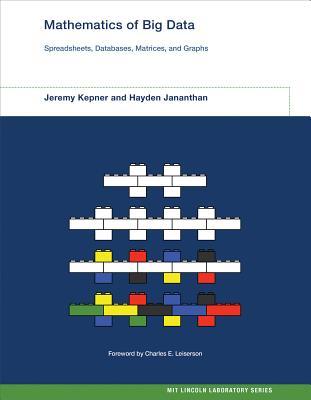
Mathematics of Big Data: Spreadsheets, Databases, Matrices, and Graphs (MIT Lincoln Laboratory Series)
by Jeremy Kepner
Sponsored
Synopsis
The first book to present the common mathematical foundations of big data analysis across a range of applications and technologies.Today, the volume, velocity, and variety of data are increasing rapidly across a range of fields, including Internet search, healthcare, finance, ...
The first book to present the common mathematical foundations of big data analysis across a range of applications and technologies.
Today, the volume, velocity, and variety of data are increasing rapidly across a range of fields, including Internet search, healthcare, finance, social media, wireless devices, and cybersecurity. Indeed, these data are growing at a rate beyond our capacity to analyze them. The tools—including spreadsheets, databases, matrices, and graphs—developed to address this challenge all reflect the need to store and operate on data as whole sets rather than as individual elements. This book presents the common mathematical foundations of these data sets that apply across many applications and technologies. Associative arrays unify and simplify data, allowing readers to look past the differences among the various tools and leverage their mathematical similarities in order to solve the hardest big data challenges.
The book first introduces the concept of the associative array in practical terms, presents the associative array manipulation system D4M (Dynamic Distributed Dimensional Data Model), and describes the application of associative arrays to graph analysis and machine learning. It provides a mathematically rigorous definition of associative arrays and describes the properties of associative arrays that arise from this definition. Finally, the book shows how concepts of linearity can be extended to encompass associative arrays. Mathematics of Big Data can be used as a textbook or reference by engineers, scientists, mathematicians, computer scientists, and software engineers who analyze big data.
Today, the volume, velocity, and variety of data are increasing rapidly across a range of fields, including Internet search, healthcare, finance, social media, wireless devices, and cybersecurity. Indeed, these data are growing at a rate beyond our capacity to analyze them. The tools—including spreadsheets, databases, matrices, and graphs—developed to address this challenge all reflect the need to store and operate on data as whole sets rather than as individual elements. This book presents the common mathematical foundations of these data sets that apply across many applications and technologies. Associative arrays unify and simplify data, allowing readers to look past the differences among the various tools and leverage their mathematical similarities in order to solve the hardest big data challenges.
The book first introduces the concept of the associative array in practical terms, presents the associative array manipulation system D4M (Dynamic Distributed Dimensional Data Model), and describes the application of associative arrays to graph analysis and machine learning. It provides a mathematically rigorous definition of associative arrays and describes the properties of associative arrays that arise from this definition. Finally, the book shows how concepts of linearity can be extended to encompass associative arrays. Mathematics of Big Data can be used as a textbook or reference by engineers, scientists, mathematicians, computer scientists, and software engineers who analyze big data.
You May Also Like

Barn av sin stad
Per Anders Fogelström

The Devil's Star
Jo Nesbø

Are You There God? It’s Me, Margaret
Judy Blume

Burn Butterfly Burn
Reese Rivers

Stop, Train, Stop! a Thomas the Tank Engine Story (Thomas & Friends) (Beginner Books(R))
W. Awdry

No Wind to Shangri-La: A Couple's 51-Day Sail to the Gambier Islands
Ralf Reiter
Comics Picks
View All![チェンソーマン 11 [Chainsaw Man 11]](https://m.media-amazon.com/images/S/compressed.photo.goodreads.com/books/1614969799i/56269317.jpg)
チェンソーマン 11 [Chainsaw Man 11]
Tatsuki Fujimoto
![ゆびさきと恋々 4 [Yubisaki to Renren 4]](https://m.media-amazon.com/images/S/compressed.photo.goodreads.com/books/1615497663i/55584973.jpg)
ゆびさきと恋々 4 [Yubisaki to Renren 4]
Suu Morishita

Warriors Graphic Novel: The Prophecies Begin #3
Erin Hunter
![気になってる人が男じゃなかった Vol. 1 [Ki ni Natteru Hito ga Otoko Janakatta, Vol. 1]](https://m.media-amazon.com/images/S/compressed.photo.goodreads.com/books/1679209103i/120730295.jpg)
気になってる人が男じゃなかった Vol. 1 [Ki ni Natteru Hito ga Otoko Janakatta, Vol. 1]
Sumiko Arai

Absolute Wonder Woman Vol. 1: The Last Amazon
Kelly Thompson

Under the Oak Tree Vol. 1
Suji Kim
