2
0
Support keeps this going.
If you find value here, a small tip makes a big difference ❤️
📍 Noticed
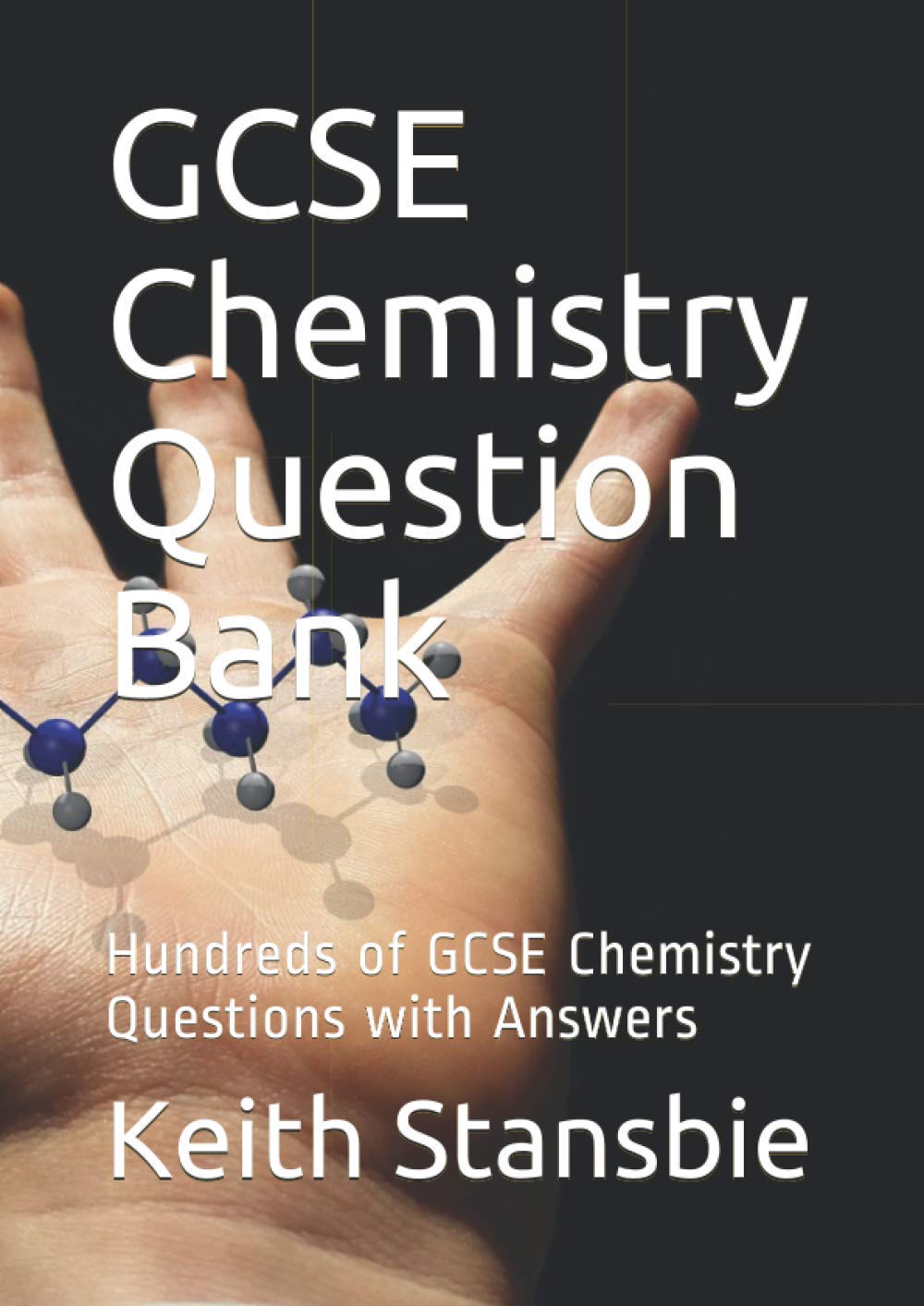
GCSE Chemistry Question Bank: Hundreds of GCSE Chemistry Questions with Answers
by Mr Keith Stansbie
Sponsored
Synopsis
Teaching Science, I have always found myself to be jealous of Maths teachers. When they set an exercise from a textbook there are always many questions for the students to practice the topic which has just been taught. Not only that but the questions are also not just from the initial perspective ...
Teaching Science, I have always found myself to be jealous of Maths teachers. When they set an exercise from a textbook there are always many questions for the students to practice the topic which has just been taught. Not only that but the questions are also not just from the initial perspective but are rearranged to find a variable which is not the subject of the equation. After that there are the questions in words rather than numbers and they always increase in difficulty throughout the exercise.The most common way in which I try to use textbooks is to set exercises from them after the topic has been introduced but I am always disappointed. It is not uncommon to find a Science textbook with just 3 or 4 questions on a topic as wide as, say, covalent bonding, and so we science teachers use worksheets.Since no book existed that met my needs, I have written one.The aim of this book is not to show students how to answer Chemistry questions – the assumption is that that has already been done by the teacher using any of the methods in their pedagogical armoury. It is to give the students chance to practice those skills more than just a couple of times and to attempt problems posed from as many angles as possible. Where there is an equation, I have set problems which require rearrangement to solve for all variables. I have given questions in simple numerical form as well as in longer, “wordier” ways. I have kept pictures to a minimum as I find examinations do this too.Where appropriate, I have given the formulae in exactly the format of the AQA Specifications 8462 and 8464. I have varied units throughout so that students are expected to convert to standard units before using formulae and, although I have attempted to keep numbers as “tidy” as possible there will be times when they will have to round to significant figures or decimal places, as stated in Mathematical Requirements (AQA Specification 8462 page 99 and AQA Specification 8464 page 163).I have tried to write everything from the point of view of the specification. You will find specification references at the beginning of every section and I have written questions relating to everything which appears within the specification. Where a section is small, I have merged it with an appropriate section. I have discovered that the concept of giving the students lots of examples has a name – SLOP! (Shed Loads Of Practice.) If, like me, you subscribe to this idea then this book is for you.This book is written in the Comic Sans Serif font as I had it recommended as the most readable font by my school’s SEN coordinator.You can also find GCSE Physics Question Bank by the same author along with the website www.teachingandmarking.com.
You May Also Like
Vintage 1960s Forgotten Recipes: A Retro Cookbook That Will Reintroduce You to the Cuisine of the Swinging Sixties (Vintage and Retro Cookbooks)
Kevin Palmer McDermott
Foundations of Nursing in the Community: Community-Oriented Practice
Marcia Stanhope

Bestiario
Juan José Arreola
Operation Entebbe: Operation Entebbe, Yonatan Netanyahu, Entebbe International Airport, Wadie Haddad, Operation Thunderbolt, Raid on Entebbe
Books LLC
You Can Draw in 30 Seconds: All it takes is a few moments of crazy courage! Step-by-step lessons to build drawing skills!
Mark Kistler

La metamorfosis de una madre: Criar en una sociedad patriarcal y adultocéntrica (Spanish Edition)
Ana Acosta Rodríguez