5
0
Support the library.
Your support helps keep books free for everyone ❤️
📍 Noticed
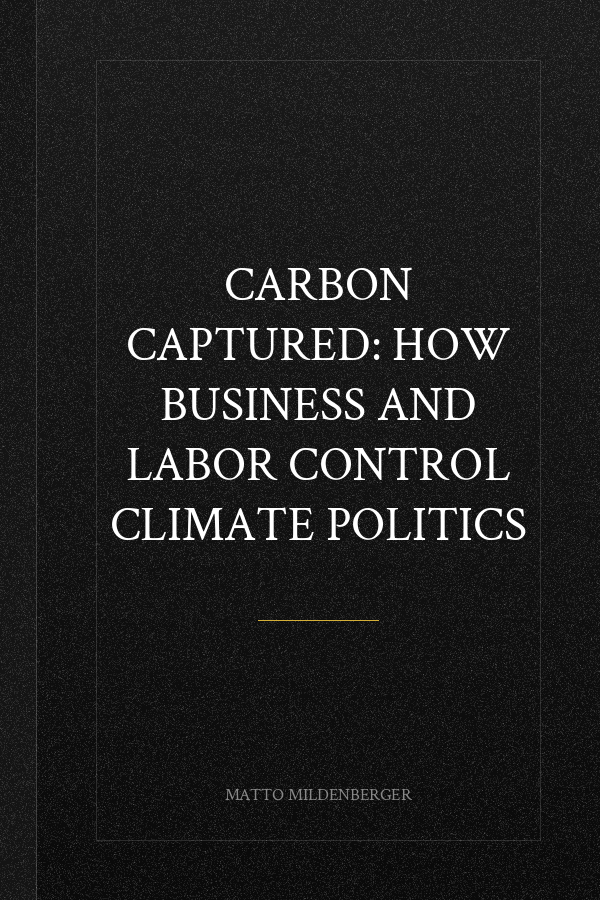
Carbon Captured: How Business and Labor Control Climate Politics
by Matto Mildenberger
Sponsored
Synopsis
A comparative examination of domestic climate politics that offers a theory for cross-national differences in domestic climate policymaking.Climate change threatens the planet, and yet policy responses have varied widely across nations. Some countries have undertaken ambitious ...
A comparative examination of domestic climate politics that offers a theory for cross-national differences in domestic climate policymaking.
Climate change threatens the planet, and yet policy responses have varied widely across nations. Some countries have undertaken ambitious programs to stave off climate disaster, others have done little, and still others have passed policies that were later rolled back. In this book, Matto Mildenberger opens the “black box” of domestic climate politics, examining policy making trajectories in several countries and offering a theoretical explanation for national differences in the climate policy process.
Mildenberger introduces the concept of double representation—when carbon polluters enjoy political representation on both the left (through industrial unions fearful of job loss) and the right (through industrial business associations fighting policy costs)—and argues that different climate policy approaches can be explained by the interaction of climate policy preferences and domestic institutions. He illustrates his theory with detailed histories of climate politics in Norway, the United States, and Australia, along with briefer discussions of policies in in Germany, Japan, the United Kingdom, and Canada. He shows that Norway systematically shielded politically connected industrial polluters from costs beginning with its pioneering carbon tax; the United States, after the failure of carbon reduction legislation, finally acted on climate reform through a series of Obama administration executive actions; and Australia's Labor and Green parties enacted an emissions trading scheme, which was subsequently repealed by a conservative Liberal party government. Ultimately, Mildenberger argues for the importance of political considerations in understanding the climate policymaking process and discusses possible future policy directions.
Climate change threatens the planet, and yet policy responses have varied widely across nations. Some countries have undertaken ambitious programs to stave off climate disaster, others have done little, and still others have passed policies that were later rolled back. In this book, Matto Mildenberger opens the “black box” of domestic climate politics, examining policy making trajectories in several countries and offering a theoretical explanation for national differences in the climate policy process.
Mildenberger introduces the concept of double representation—when carbon polluters enjoy political representation on both the left (through industrial unions fearful of job loss) and the right (through industrial business associations fighting policy costs)—and argues that different climate policy approaches can be explained by the interaction of climate policy preferences and domestic institutions. He illustrates his theory with detailed histories of climate politics in Norway, the United States, and Australia, along with briefer discussions of policies in in Germany, Japan, the United Kingdom, and Canada. He shows that Norway systematically shielded politically connected industrial polluters from costs beginning with its pioneering carbon tax; the United States, after the failure of carbon reduction legislation, finally acted on climate reform through a series of Obama administration executive actions; and Australia's Labor and Green parties enacted an emissions trading scheme, which was subsequently repealed by a conservative Liberal party government. Ultimately, Mildenberger argues for the importance of political considerations in understanding the climate policymaking process and discusses possible future policy directions.
You May Also Like

Lethal Kiss
Taylor Grothe

Turning Your Mess Into A Message: From Adversity to Advantage
Michael Berggreen
Captive Genders: Trans Embodiment and the Prison Industrial Complex
Eric A. Stanley

Laboratory Animal and Exotic Pet Medicine: Principles and Procedures
Margi Sirois

Parasitic Mind: How Infectious Ideas Are Killing Common Sense
Gad Saad

The Screwtape Letters
C.S. Lewis

![ゆびさきと恋々 4 [Yubisaki to Renren 4]](https://m.media-amazon.com/images/S/compressed.photo.goodreads.com/books/1615497663i/55584973.jpg)

![나 혼자만 레벨업 9 [Na Honjaman Level Up 9]](https://m.media-amazon.com/images/S/compressed.photo.goodreads.com/books/1692032563i/196790145.jpg)
![呪術廻戦 27 [Jujutsu Kaisen 27]](https://m.media-amazon.com/images/S/compressed.photo.goodreads.com/books/1721100820i/201817682.jpg)

