5
0
Support the library.
Your support helps keep books free for everyone ❤️
📍 Noticed
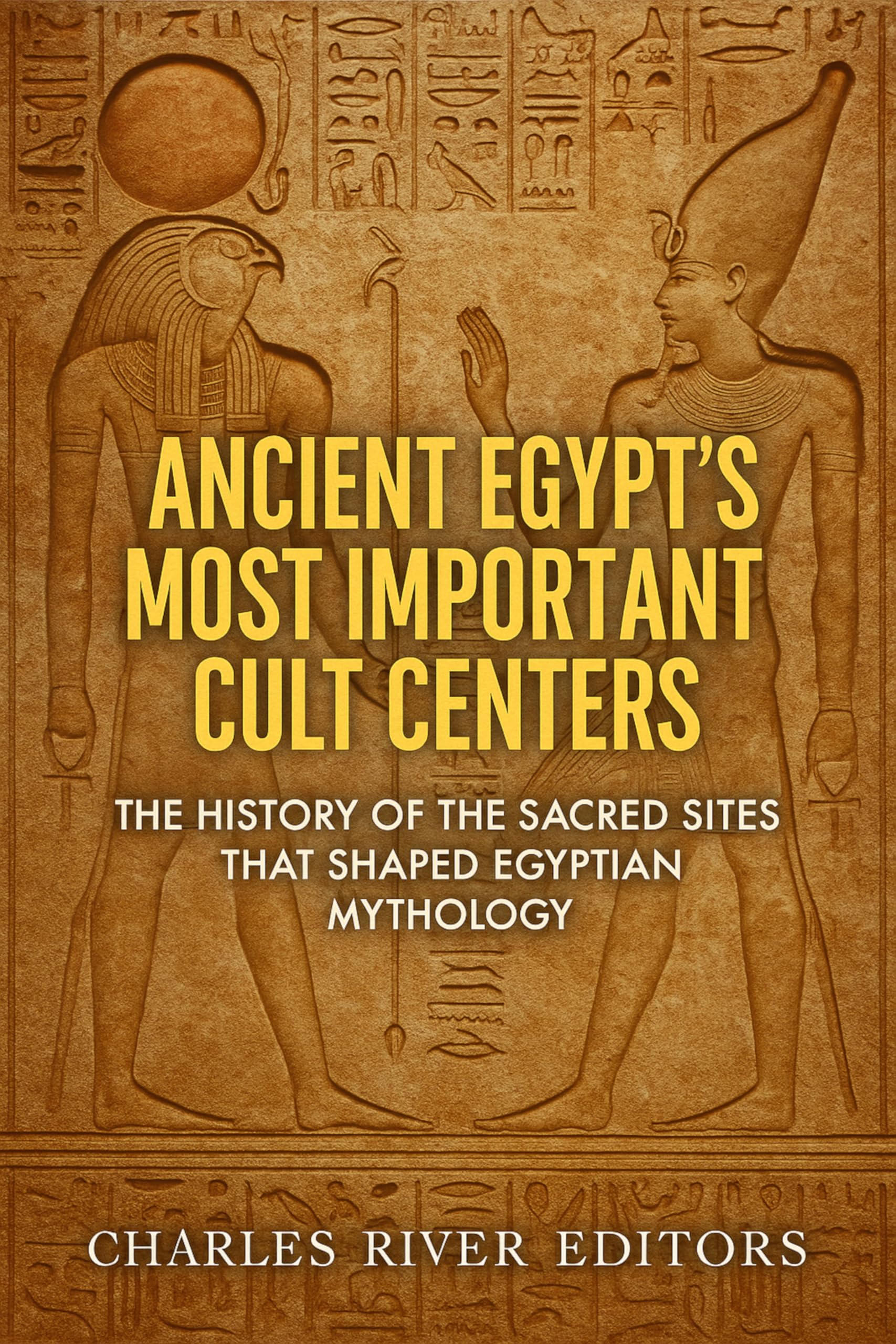
Ancient Egypt’s Most Important Cult Centers: The History of the Sacred Sites that Shaped Egyptian Mythology
by Charles River Editors
Sponsored
Synopsis
Africa may have given rise to the first human beings, and Egypt probably gave rise to the first great civilizations, which continue to fascinate modern societies across the globe nearly 5,000 years later. From the Library and Lighthouse of Alexandria to the Great Pyramid at Giza, the ancient ...
Africa may have given rise to the first human beings, and Egypt probably gave rise to the first great civilizations, which continue to fascinate modern societies across the globe nearly 5,000 years later. From the Library and Lighthouse of Alexandria to the Great Pyramid at Giza, the ancient Egyptians produced several wonders of the world, revolutionized architecture and construction, created some of the world’s first systems of mathematics and medicine, and established language and art that spread across the known world. With world-famous leaders like King Tut and Cleopatra, it’s no wonder that today’s world has so many Egyptologists.
What makes the accomplishments of the ancient Egyptians all the more remarkable is that Egypt was historically a place of great political turbulence. Its position made it both valuable and vulnerable to tribes across the Mediterranean and the Middle East, and ancient Egypt had no shortage of its own internecine warfare. Its most famous conquerors would come from Europe, with Alexander the Great laying the groundwork for the Hellenic Ptolemy line and the Romans extinguishing that line after defeating Cleopatra and driving her to suicide.
Perhaps the most intriguing aspect of ancient Egyptian civilization was its inception from the ground up, as the ancient Egyptians had no prior civilization which they could use as a template. In fact, ancient Egypt itself became a template for the civilizations that followed. The Greeks and the Romans were so impressed with Egyptian culture that they often attributed many attributes of their own culture‒usually erroneously‒to the Egyptians. With that said, some minor elements of ancient Egyptian culture were, indeed, passed on to later civilizations. Egyptian statuary appears to have had an initial influence on the Greek version, and the ancient Egyptian language continued long after the pharaonic period in the form of the Coptic language.
Although the Egyptians may not have passed their civilization directly on to later peoples, the key elements that comprised Egyptian civilization - their religion, early ideas of state, and art and architecture - can be seen in other pre-modern civilizations. Indeed, since Egyptian civilization represented some fundamental human concepts, a study of their culture can be useful when trying to understand many other pre-modern cultures.
One of the primary reasons why modern scholars know so much about Egyptian history is due to many monuments found up and down the Nile. Although some of the tombs built on the west bank of the Nile River have suffered a fair amount of wind damage and all of the great monuments have endured the ravages of time, they are amazingly well-preserved, thanks both to Egypt’s arid climate and good workmanship. The Egyptian monument builders were truly a class above their contemporaries in terms of their trade, which was helped by the fact that they worked with the more permanent materials of sandstone and limestone, unlike Mesopotamian builders who were forced to primarily work with mud and brick.
In ancient Egypt, cities held political and religious significance, which meant that if the political or religious tides changed, so too could the fortunes of particular cities. Memphis is perhaps the best known of ancient Egypt’s cities because it was fortunate enough to be the political capital of the Egyptian state for most of its history. Hundreds of miles to Memphis’ south, Thebes became an important city during the Middle Kingdom and its stature grew during the New Kingdom when many of the pharaohs came from there and the national god, Amun, had its cult center in the city. Other cities, such as Tanis and Sais, were important for much shorter periods in Egyptian history.
You May Also Like
Scottish Bastards: Perceptions of illegitimacy in Scotland
Alex Wood

Unhinged
Vera Valentine
Curriculum Leadership: Strategies for Development and Implementation
Allan A. Glatthorn
Last Mission to Tokyo: The Extraordinary Story of the Doolittle Raiders and Their Final Fight for Justice
Michel Paradis

The Christian Girl Energy Journal
Sunday Mornings

Nash Falls
David Baldacci


